Saturday, 14 December 2019

Poems by Tuli Kupferberg (1957)

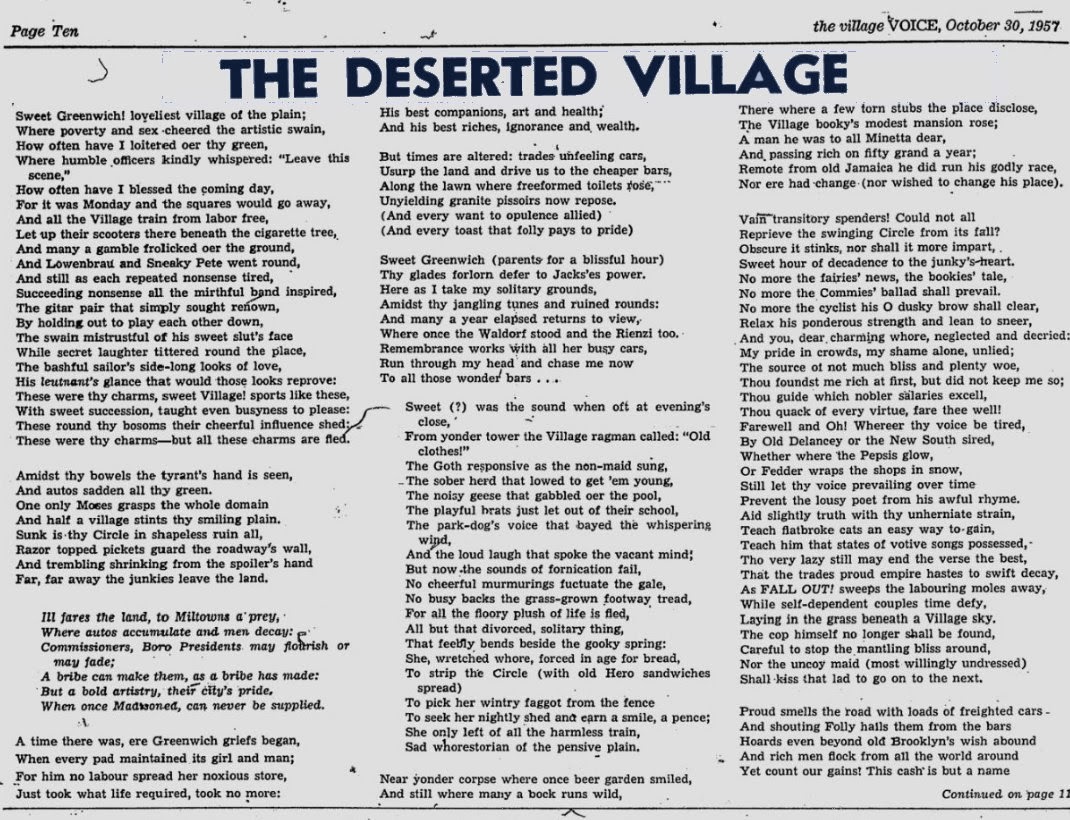
I came across these poems by Tuli Kupferberg (The Fugs) in the Village Voice. I'm posting them for their rarity. I'm no poetry critic so make your own mind up on their merits..


The Village Voice - Apr 3, 1957

The Village Voice - Jul 31, 1957

The Village Voice - May 8, 1957

The Village Voice - Oct 2, 1957

Kliban - Artwork for Plastic Bertrand 45RPM single (1983)


I'm not a particular fan of Kliban's cat cartoons, but I've included these as Kliban only did one other record sleeve illustration.


Kliban Cartoon - The Realist, Apr 1964. Issue 49

 from The Realist, Apr 1964. Issue 49 - also reprinted in Dec-Jan 1964, Issue 55 

Sunday, 11 November 2018

Who was Milo E. Zerbst?

Can anyone provide any biographical information about the artist Milo E. Zerbst?

I own rather nice watercolour study by him that I purchased cheaply from a charity shop in SW.England.

He appears to have been a landscape watercolourist and oil-painter and that's about all I know for certain. I think he was probably German and appears to have been active from the 1930's to the early-1960's.

I've found a handful of other images of his work, on various auction-sites, but very little additional information.

He appears to have provided illustrations for several German books published between the late-1950's and early-60's. This is what make's me think he was German.

  • Abenteuerliche Märchen der Gebrüder Grimm. Published Hamburg: Hamburger Lesehefte-Verlag. 1958.
  • Kriminalistische Anekdoten by Kurt Höllrigl. Published by Hamburg. Kriminalistik 1959
  • Die klugen Tiere. Ein Fabelbuch by Aesop. Published by Hamburg, Hamburger Lesehefte Verlag 1962
Please post comments if you know more about this artist. Thanks


On the origins of "Mouldy Old Dough"


This post is the result of about 20 years of research and accidental discoveries, and concerns the origins of the phrase "Mouldy Old Dough".

I first heard the phrase as the title of the superb 1972 No.1 UK hit by Lieutenant Pigeon. But what I found quite curious was that John Lennon also mentions this phrase in an apparent ad-lib during the song "Ain't She Sweet" (Ager/Yellen). This would be the 24th July 1969 version that appears on the Beatles Anthology 3 collection.

Why would John Lennon utter the title of a song yet to be recorded? I initially thought this phrase must be part of (un)common English parlance. Perhaps a slang term used in the English Midlands?

The Anthology 3 inlay says the Beatles 1969 version of "Ain't She Sweet" closely follows the Gene Vincent 1956 version, but his version omits the phrase.

I was puzzled by this curious phrase and song title : what were its origins and was there some underlying meaning to the phrase?  Perhaps something more that a straightforward reading might otherwise suggest?

This remained a puzzle for many years until I heard Harry Reser's Six Jumping Jacks jaunty 1926 hit-tune "Lo-do-de-o" - the wonders of Shazam allowed me to quickly identify the artist. The phrase "Lo-do-de-o" is mentioned several times in the song. For example, this phrase is sung at 1m13 and again even-more-clearly at 1m30, where it sounds indistinguishable from "Mouldy Old Dough".

The lyrics also provide a hint at a meaning, and perhaps unsurprisingly, the phrase appears to be a synonym for sex.

Take my advise and learn how to do it,
You'll find there's nothing to it,
If you like a-her and she likes a-you,
You like a-love and a-bill and a-coo,
Learn how to sing and a-play and a-do,
that mould-dough-de-old dough

Once I'd identified that "Lo-do-de-o" or "Mouldy Old Dough" is a piece of 1920's jazz-era slang, I found a number of further similar-sounding occurrences. It seems likely that this phrase could be used to refer to sex and avoid the censors.

Other later appearances include the 1927 songs "Crazy Words, Crazy Tune" and "Vo-Do-Do-De-O Blues" both by Ager/Yellen. However, neither of these sound as similar to the "Mouldy Old Dough" example found in the 1926 Harry Reser recording.

"Crazy Words, Crazy Tune" (Ager / Yellen)
Irving Aaronson and his Commanders in 1927
Johnny Marvin in 1927
Frank Crumit also in 1927
Savoy Havana Band in 1927
Winifred Atwell in 1952
Jim Kweskin Jug Band in 1963

"Vo-Do-Do-De-O Blues" (Ager / Yellen)
California Ramblers in 1927
The Goofus Five in 1927
The Temperance Seven in 1961

Furthermore, the phrase "Vo-De-Oh-Do" appears in the closing seconds of the late-1966 No.1 UK hit "Winchester Cathedral" by The New Vaudeville Band.

However, all these other songs and versions post-date Harry Reser's July 1926 recording of "Lo-do-de-o" song which is the earliest known appearance of this phrase.

This song was recorded in July 1926 and was first released on Brunswick no.3252-B [ref: Brunswick Records: A Discography of Recordings, 1916-1931, Volume 1]

This appears to be the origin of the phrase, but I still find it quite strange that John Lennon should repeat this phrase in 1969. The most likely explanation is that he'd heard Harry Reser's 1926 song, or perhaps the phrase uttered during the refrain of the 1966  No.1 record "Winchester Cathedral" was his source?

Do any other earlier recordings or sources of this phrase exist? If you know of any, please add a comment.

Wednesday, 13 December 2017

Kliban article from 1978

Here's a short biographic piece about cartoonist B. Kliban from "The Montreal Gazette" dated Feb 7, 1978.

Full text is below.


The Montreal Gazette, Feb 7, 1978
NEW YORK — (Special) — Benjamin? Barry? Bernard? Bazooka? Blimp? Bemidji? Benelux? Banana Republic?

Try Bashful

B. Kliban, one-man phenomenon, creator of cat cards, the 'Cat Calendar,' cat posters and 'Cat' — the book of cartoons that started it all — is stingy with details of his private life, among them his first name. Depending on whom you ask. Kliban either dislikes his name or considers it unimportant.

Kliban has no interest in being a celebrity. He has managed, so far, to avoid talking to 'People' magazine and other media representatives who've asked, says Workman Publishing Co. publicist Jennifer Rogers. Last summer Kliban did submit to a telephone interview with 'Publisher's Weekly', when we sat on his head.' Rogers noted "He's a wonderful, charming, marvelous man, Rogers said, "But he has taken a very reasoned position on his personal life, about things he feels would be of interest to no one but him. Don't ask him questions like 'What does the B stand for?' He thinks its a fairly frivolous question, he'll say it stands for balloon. And he's bored with talking about cats." But people are anything but bored with Kliban's cats. One man reported receiving three cat cards and a calendar from four different people in four, different states.

Perhaps the secret of the cats' popularity is that they are very human and still quintessential cats. On the "Cat Calendar," for example. Julys entry is floating in a swimming pool, around the perimeter of which is piled a stack of laden kitty dishes and a bowl of goldfish. October's cats are of the alley variety, all set to go trick-or-treating. One is wearing a Nixon mask.

Kliban is not anti-social. For one thing, he answers all his fan mail. "I feel compelled to answer it." he said in a telephone interview from his San Francisco studio.

He prefers not to deal with fame, the gee-its-really-him kind of fame that confronts celebrities when they go out to dinner "There are times when I find it embarrassing" he said. Few people recognize him because he has rarely been photographed. Neither photo nor blurb appears on any of his published work.

A Connecticut native, Klibam has lived in California since 1959, earning a living as a cartoonist and commercial artist. Among other things, during his pre-'Cat' years, Kliban worked on annual reports for Kaiser Aluminum and advertisements and logos for various clients. His attitude toward that kind of work is perhaps summed up in one of his cartoons. Entitled 'The Birth of Advertising,' it depicts little men in gray flannel suits dropping from a horse's posterior.

"It's all autobiographical, Kliban said of his work in general. “Any artist's work is autobiographical."

Klihan's big break occurred when 'Playboy' magazine began publishing his cartoons. Michelle Urry, 'Playboy's cartoon editor paid a visit to Kliban's studio and discovered his cats. He was drawing cats when he wasn't drawing what he was supposed to," Rogers said.

It was Urry who bound the bestiary and trundled it back to New York in 1975 "I think we can sell this." she said With a minimum of advertising. a phenomenon was born The Cat book was a word-of-mouth hit And then people began stealing the posters advertising the book That's when the related products came into being.

One source close to Kliban compares what has happened to Kliban with what happened (over a much longer period of time) to Charles Schulz' 'Peanuts. When 'Peanuts' first caught on, the same thing happened" she said. And while there are no Kliban lunch boxes or pencil sharpeners, there are T-shirts and puzzles and other projects yet unseen.

Kliban is divorced and has a 12-year-old daughter. He once had four cats. And his next major project is this 'All I want to do is paint landscapes," Kliban said, "watercolor landscapes".


Kliban - 1980 Christmas catalog

Another example of Kliban's commercial work. This time, a cover for a Neiman-Marcus Christmas Catalog dated 1980.

Kliban Neiman-Marcus Christmas Catalog (1980)